
Over the past decade, one technology has quietly transformed the automotive industry: perception.
From Level 2 driver assistance to the rapid evolution of Level 3 and Level 4 autonomous driving, modern vehicles are becoming increasingly capable of understanding the world around them. Cameras, millimeter-wave radars and LiDAR sensors now work together to detect obstacles, recognise road users and interpret complex traffic scenarios in real time.
Today s premium vehicles often integrate dozens of sensors to build a comprehensive picture of their surroundings. Instead of relying solely on the driver s vision, they continuously collect environmental data, helping identify potential risks long before they become immediate dangers. The result is not simply smarter vehicles, but safer and more intuitive mobility. Intelligence is no longer measured only by horsepower or battery capacity. It is increasingly defined by how well a vehicle perceives its environment.
Urban Cycling Has Changed. E-bikes Haven t.
Across Europe, e-bikes have become one of the fastest-growing forms of urban mobility. Governments continue investing in cycling infrastructure, while millions of commuters choose electric bicycles for cleaner, healthier and more efficient transportation. At the same time, however, the urban environment has become significantly more complex.
Cyclists now share road space with cars, buses, delivery riders, e-scooters and pedestrians, all moving at different speeds and often behaving unpredictably. Blind intersections, temporary roadworks, and poor visibility during rain or night riding have become everyday realities rather than exceptional situations. Despite these changes, the way most e-bikes perceive the road has barely evolved.
Manufacturers have spent years improving battery capacity, motor performance and vehicle weight. These innovations have made riding easier, but they have not fundamentally changed how riders interact with increasingly unpredictable traffic. Most decisions still depend entirely on what the rider can see and how quickly they can react.
The Next Evolution of Electric bikes
This raises an important question for the industry. If intelligent perception has become an essential part of modern mobility, why shouldn t it become part of the future of cycling?
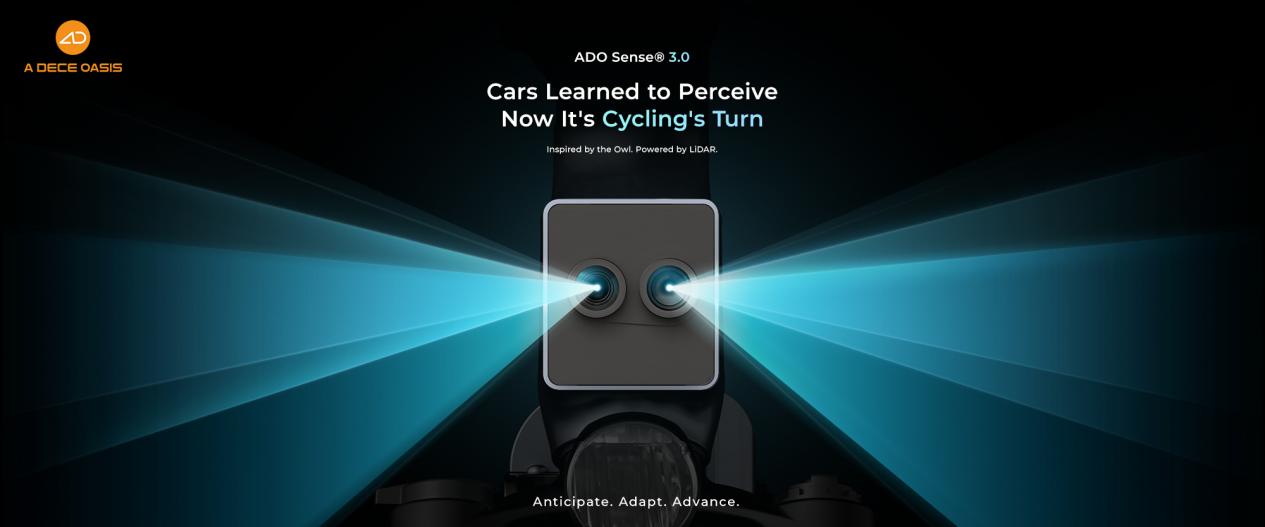
ADO believes the next generation of e-bikes should not only assist riders with electric power, but also with environmental awareness. „We believe the next generation of e-bikes should not only assist riders electrically, but also with genuine environmental awareness,“ says Mr. Sen, Founder of ADO E-Bike. This belief has led to the development of ADO Sense 3.0, ADO s LiDAR-based perception technology designed specifically for electric bicycles.
Rather than focusing solely on speed or power, ADO Sense 3.0 explores how intelligent perception can help e-bikes better understand their surroundings and support smoother, more confident urban riding. Combined with automatic shifting technology, intelligent perception opens the possibility for a new generation of e-bikes that not only respond to rider input, but also adapt more naturally to changing road conditions.
A New Direction for Urban Mobility
Just as electric assistance transformed cycling over the past decade, perception assistance may become the next milestone for the industry.The future of e-bikes may not be defined by how much power they deliver. Instead, it may be defined by how well they understand the road.
Discover how ADO Sense 3.0 is bringing intelligent perception to the next generation of e-bikes.
UK: https://adoebike.co.uk/pages/worlds-first-lidar-electric-bike
EU: https://adoebike.com/pages/worlds-first-lidar-electric-bike

Cars Have Entered the Era of Intelligent Perception. Why Are E-bikes Still Riding Without It? hinzugefügt von Presse am
Alle Beiträge von Presse →
